


When using Artificial Intelligence (AI) for marketing, one of the biggest mistakes people make is accepting the first answer ChatGPT provides. While AI can generate ideas, headlines, marketing messages and campaign strategies within seconds, the first response is not necessarily the best one.
Think of ChatGPT as a brainstorming partner rather than a tool that simply gives you the answers. Its real value lies in helping you explore different possibilities, consider alternative approaches and discover ideas that you might not have thought of yourself.
Instead of asking ChatGPT for one marketing idea and immediately using it, try asking for 5, 10 or even 20 alternatives. You can then compare the suggestions, identify the strongest options and refine them until you find an approach that suits your business objectives.
This simple change in how you interact with AI can significantly improve the quality of your marketing content.
Marketing is rarely about finding just one way to promote a product or service. Different customers respond to different messages, and the same product can be positioned in several ways depending on the target audience, campaign objectives and marketing platform.
For example, imagine that you are promoting an online AI training programme. Your first instinct might be to advertise it using a straightforward message such as:
“Learn AI Skills to Improve Your Productivity.”
Although this message communicates the benefit, it is only one possible marketing direction. What if your audience is more interested in saving time, improving their career prospects or helping their team become more efficient? Each of these motivations presents an opportunity to develop a different marketing angle. By asking ChatGPT to generate multiple ideas, you can explore different perspectives before deciding which message deserves your attention.
The objective is not simply to produce more content, but to give yourself more choices and make better marketing decisions.
A useful way to approach this is to ask ChatGPT to generate marketing ideas based on different customer motivations.
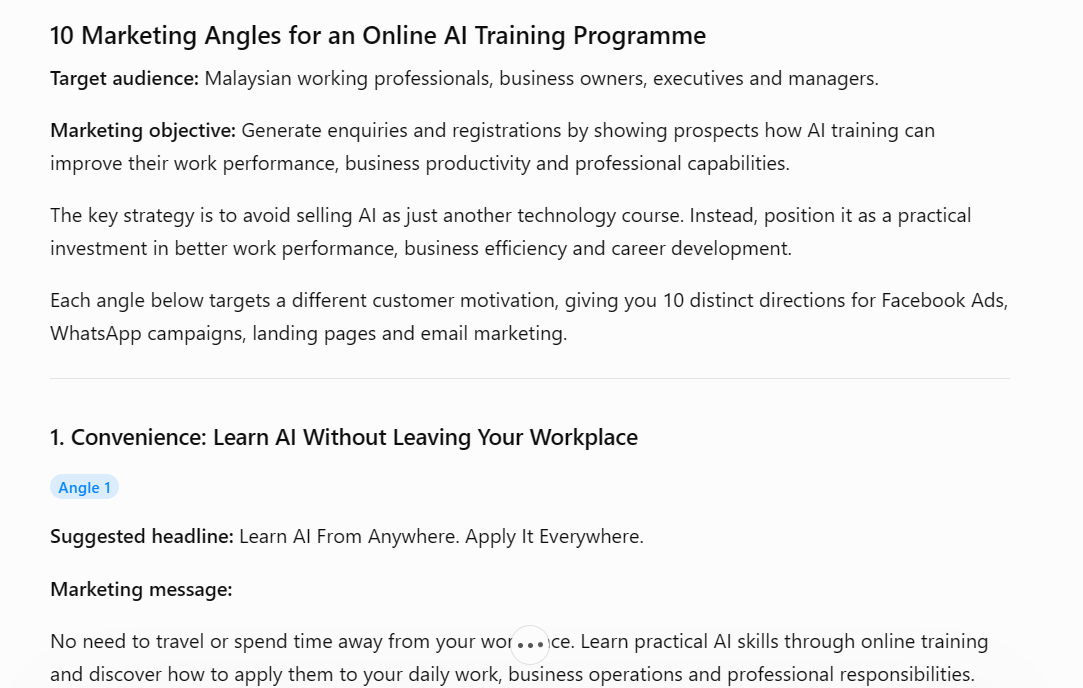
For example, if you are promoting an online AI training programme, you could ask ChatGPT to explore these ten marketing angles:
Notice how each angle communicates a different reason to consider the same training programme. Rather than repeatedly promoting the course using the same message, you now have ten different directions to develop into advertisements, social media posts, website headlines or email campaigns.
The quality of ChatGPT’s suggestions depends partly on the instructions you provide. Simply asking for ten marketing ideas may produce generic suggestions that do not fully reflect your business, audience or campaign objectives.
A more effective approach is to provide some context and clearly explain what you want ChatGPT to generate.
Here is an example of a prompt you can use:
Example ChatGPT Prompt:
“Act as an experienced digital marketing strategist. I am promoting an online AI training programme targeting working professionals, business owners and managers.
Generate 10 different marketing angles that I can use to promote this programme.
Explore the following perspectives:
For each marketing angle, provide:
Avoid repeating similar ideas. Make the suggestions practical, persuasive and relevant to Malaysian working professionals.”
This prompt gives ChatGPT a clearer understanding of the task, allowing it to produce ideas that are more relevant to your marketing objectives.
Once ChatGPT has generated several suggestions, the next step is to evaluate them rather than automatically choosing the first one.
Not every marketing angle will be equally effective for your campaign. Some may be more suitable for attracting attention, while others may be better for explaining the value of your product or encouraging potential customers to take action.
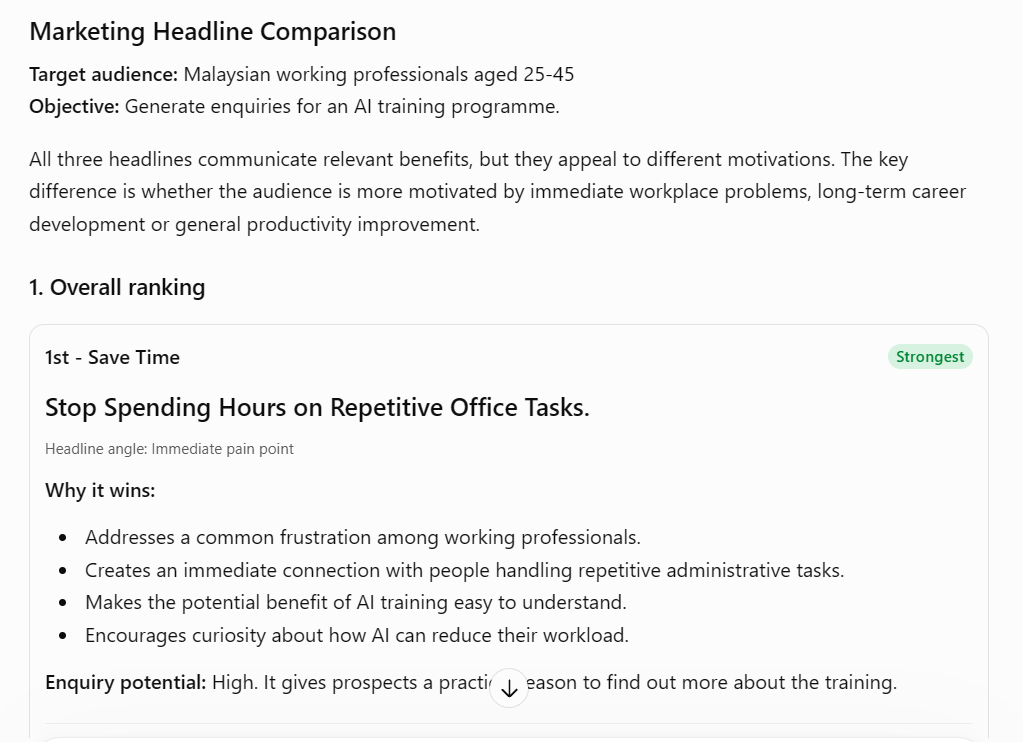
For example, consider these three possible headlines for an AI training programme:
All three promote the same programme, but each appeals to a different customer motivation. The first headline focuses on a common workplace frustration, while the second highlights professional development and the third emphasises productivity.
You can take this comparison one step further by asking ChatGPT to evaluate the suggestions.
Example Follow-up Prompt:
“Compare these three marketing headlines based on their ability to attract working professionals aged 25 to 45. Evaluate their relevance, emotional appeal, clarity and potential to generate enquiries. Rank them from strongest to weakest and explain your reasoning.”
This allows you to use AI not only as an idea generator, but also as an assistant for evaluating creative options.
However, remember that ChatGPT’s evaluation is a starting point rather than proof of actual campaign performance. You should still consider your audience, business objectives and previous marketing results when making the final decision.
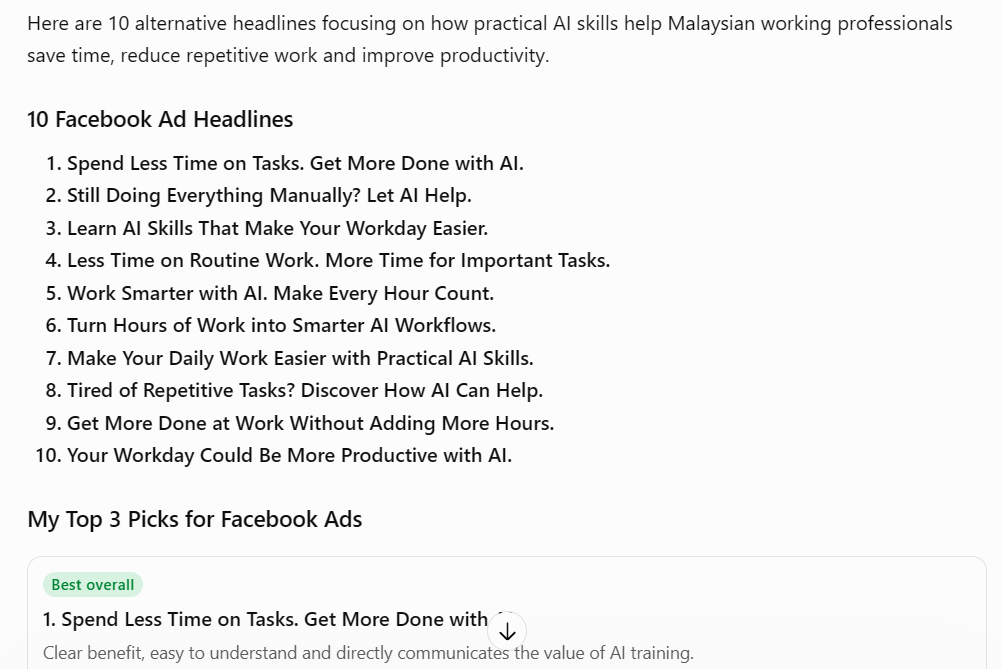
After comparing the suggestions, identify the strongest marketing angles and ask ChatGPT to develop them further. For instance, you may decide that the time-saving angle is particularly relevant because your target audience consists of busy office professionals. Instead of accepting the original headline, you could ask ChatGPT to produce ten variations with different approaches.
Example Follow-up Prompt:
“I like the time-saving marketing angle. Generate 10 alternative headlines based on this concept.
Make the headlines suitable for Facebook advertisements targeting Malaysian working professionals. Use natural, attention-grabbing language and focus on the benefits of learning practical AI skills.
Avoid exaggerated claims and generic phrases. Keep each headline concise and persuasive.”
You can then compare the new headlines and select the ones that best communicate your message. You could also ask ChatGPT to adapt the selected idea into different content formats, including Facebook advertisements, Instagram captions, website banners, email subject lines and WhatsApp promotional messages. This creates a more structured content development process, where one strong marketing angle can be transformed into several marketing assets without losing the original campaign message.
Asking for multiple ideas is particularly useful when planning campaigns across different marketing channels. For example, a Facebook advertisement may need a strong headline that immediately captures attention, while a website landing page requires a more informative message that explains the benefits of the programme.
Similarly, an email campaign may focus on providing useful information, whereas a WhatsApp follow-up message should be more conversational and direct. Rather than creating every piece of content from scratch, you can ask ChatGPT to adapt your selected marketing angle to suit each platform.
Consider a campaign promoting an AI training programme using the time-saving angle:
The core message remains consistent, but the presentation changes according to the communication channel. This approach helps maintain campaign consistency while ensuring that your content is suitable for different audience touchpoints.
Although ChatGPT can generate hundreds of ideas in a short period, more suggestions do not automatically translate into better marketing.
You still need to evaluate whether the suggestions are accurate, relevant and suitable for your target audience. Some ideas may sound creative but fail to communicate the actual benefits of your product, while others may contain claims that your business cannot substantiate.
This is why human judgement remains an important part of the marketing process. Use ChatGPT to explore possibilities, challenge your initial thinking and develop alternative approaches, but make the final decision based on your understanding of the business and its customers.
You should also consider testing different marketing angles through actual campaigns. For example, you could run two Facebook advertisements with different headlines and compare their click-through rates, enquiry volume and conversion performance. The results can help you understand which messages resonate more strongly with your audience, allowing you to make more informed decisions for future campaigns.
One of the most useful ways to improve your experience with ChatGPT is to stop treating its first response as the final answer.
Instead of asking for one idea, ask for ten alternatives. Instead of immediately choosing a headline, compare several approaches. Once you identify a promising direction, ask ChatGPT to refine it and adapt it to different marketing platforms. Remember, marketing is often about finding the right angle, not simply finding the right words.
A product can be promoted through convenience, value, quality, productivity, emotional appeal and many other perspectives. Exploring these possibilities gives you more opportunities to connect with your target audience. AI makes this brainstorming process faster and more accessible, but the ability to recognise a good idea and turn it into an effective marketing campaign still depends on your judgement and understanding of your customers.
The next time you use ChatGPT for marketing, don’t settle for the first answer. Ask for more ideas, compare your options and discover a better way to communicate your message.


