Enterprise Trust, Security, and Scaling Gemini Notebook Across Your Management Team
Over the course of this series, we have explored how Gemini Notebook transforms executive workflows - moving leaders away from ad-hoc prompting and surface-level chat tools toward rigorous, source-grounded intelligence hubs. In Part 1, we established how to structure and set up executive notebooks effectively. In Part 2, we examined high-impact management use cases, from rapid market report synthesis to board deck preparation and cross-departmental risk analysis.
However, for C-suite leaders, directors, and department heads, introducing any new artificial intelligence tool into an enterprise environment inevitably raises critical questions:
Where does our proprietary data go?
Is our intellectual property used to train public models?
How do we govern access across different business units securely?
In this concluding installment, we examine the enterprise-grade security architecture behind Gemini Notebook, how privacy is maintained, and best practices for scaling this tool safely across your management team.
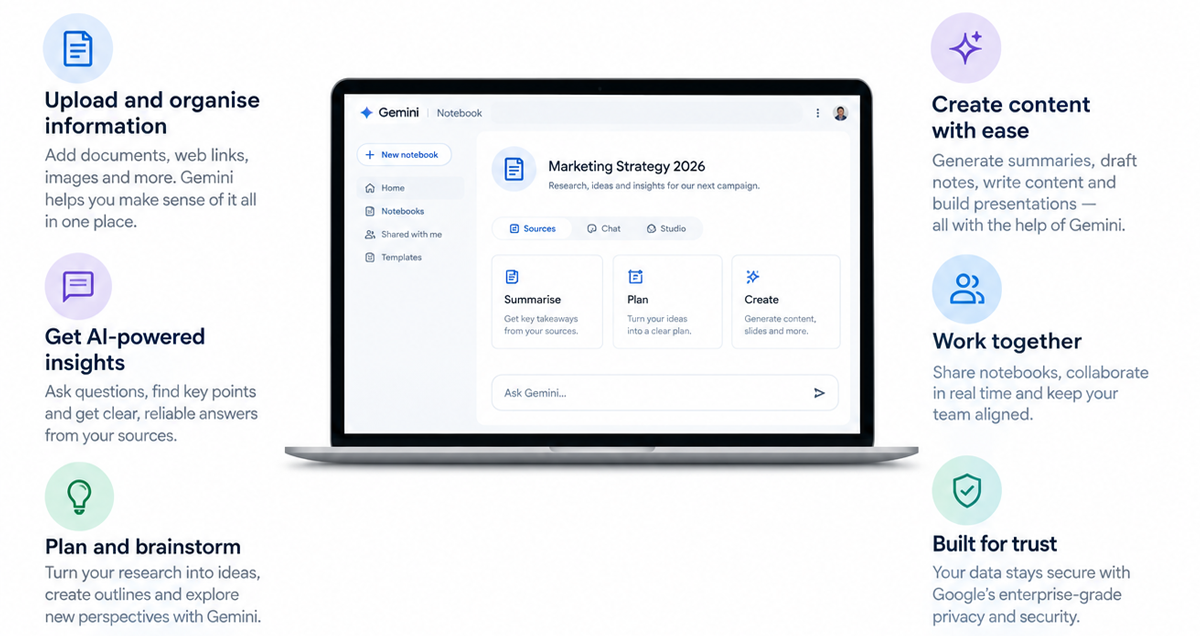
An overview of Gemini' Notebook's features
1. The Security Imperative: Why Public LLM Chatbots Fail Enterprise Standards
When managers experiment with consumer-grade AI chat tools, they often input sensitive materials—financial figures, unreleased product roadmaps, personnel evaluations, and proprietary client data. This practice introduces severe organisational risks:
Public Model Training: On many standard consumer AI platforms, conversational inputs and uploaded files are automatically ingested to train future public model iterations. This creates a direct pathway for confidential corporate data to inadvertently leak into public model responses.
Data Residency and Compliance Blind Spots: Standard chat interfaces frequently lack the granular access controls and compliance certifications required by corporate governance frameworks, exposing firms to regulatory penalties or breach liabilities.
Gemini Notebook was architected from the ground up to solve these enterprise concerns, establishing a secure boundary between your organisation’s proprietary assets and public AI infrastructure.
2. Core Security Pillars of Gemini Notebook
Understanding how Gemini Notebook protects your data gives management the confidence to deploy it across sensitive business domains.
Strict Non-Training Guarantee for Enterprise Data: Your private files, uploaded documents, notes, and conversational interactions within Gemini Notebook are never used to train Google’s foundation models or public AI systems. Your data remains strictly yours.
Isolated Workspace Boundaries: Each notebook functions as an independent, closed-loop environment. Information uploaded to a financial strategy notebook cannot cross over or contaminate other workspaces unless explicitly shared or duplicated by authorised users.
Inherited Google Cloud Security Standards: Built on Google’s robust enterprise infrastructure, Gemini Notebook benefits from industry-leading encryption standards—both in transit and at rest—ensuring that confidential corporate documents are shielded against unauthorised interception or access.
3. Establishing Governance and Access Control Protocols
Deploying Gemini Notebook successfully across a management team requires clear internal governance. To prevent disorganised “shadow AI” usage, leaders should implement a structured rollout strategy:
Define Ownership by Department: Assign clear ownership for key notebooks. For instance, the Chief Financial Officer or designated finance leads should own the Q4 Financial Planning notebook, while marketing directors oversee competitor intelligence repositories. Clear ownership ensures that documents are regularly audited, updated, and purged when obsolete.
Standardise Naming and Tagging Conventions: Establish organisational guidelines for how files are named and structured before upload (e.g., incorporating version numbers, department codes, and dates). This prevents team members from querying outdated strategic drafts.
Implement Document Lifecycle Audits: Set a quarterly review cycle to archive or delete outdated market reports, old policy drafts, and superseded budgets. Keeping notebooks lean and current ensures high response accuracy and prevents the AI from referencing deprecated business directives.
4. Scaling the Tool Across the Organisation
Once security baselines and governance protocols are established, scaling Gemini Notebook across middle and senior management unlocks enterprise-wide efficiency:
Cross-Functional Collaboration: Share curated notebooks with cross-functional project teams so everyone operates from a unified repository of truth during complex product rollouts or regional expansions.
Accelerated Decision-Making Cycles: By equipping every manager with a secure, instant synthesis engine, organisations eliminate bottlenecks where decisions stall waiting for manual document reviews or status updates.
Conclusion: Reclaiming Strategy Through Secure AI
The modern management challenge is rarely a shortage of information; it is the friction of processing it securely and accurately.
By moving past the limitations of standard public chatbots, leveraging rigorous source grounding, and relying on enterprise-grade data protection, Gemini Notebook empowers leaders to turn scattered document archives into an active, secure strategic advantage. By setting up structured notebooks, applying them to core executive workflows, and enforcing robust governance, your management team can reclaim valuable hours, eliminate guesswork, and lead with absolute confidence.
Want to Help Your Team Use AI More Effectively?
Think of AI an your capable assistant. You don't need to become programmers or AI specialists to start benefiting from it. The key is understanding how to apply AI to the work they already do every day.
Not sure how to begin? Start the conversation with our team today.
Have a project in mind or need expert advice on your digital strategy? Drop us a line. Our team is ready to turn your challenges into measurable success.