 Our Team
 Our Clients
 +6017-711 5462
 Whatsapp Us


NSRF: Malaysia’s Blueprint for Global ESG Leadership
Jul 17, 2026 - Events & Activities
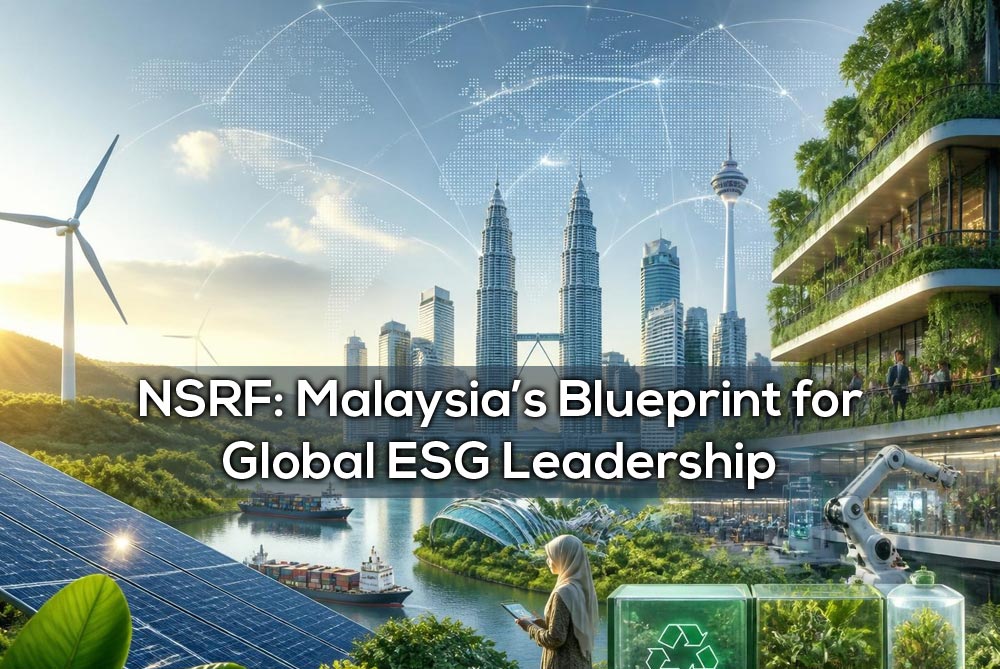
For decades, "sustainability" in the Malaysian corporate world was often viewed as a voluntary badge of honour, a "nice-to-have" section in an annual report. That era has officially come to an end. With the launch of the National Sustainability Reporting Framework (NSRF), Malaysia is shifting from voluntary disclosures to a regulated, standardised, and globally aligned reporting ecosystem.
Developed by the Advisory Committee on Sustainability Reporting (ACSR)—a powerhouse committee including the Securities Commission, Bank Negara Malaysia, and Bursa Malaysia—the NSRF is the nation’s definitive roadmap for adopting international climate standards.
Here is everything Malaysian business leaders need to know about the NSRF’s key pillars and the critical timeline for compliance.
Key Pillars of the NSRF
The framework is designed to move beyond voluntary disclosures to a regulated baseline that provides investors with consistent, comparable, and reliable data.
- Global Alignment: The NSRF uses International Sustainability Standards Board (ISSB) standards as the baseline to enhance Malaysia’s attractiveness to international investors managing over US$120 trillion in assets.
- PACE Initiative: To support implementation, the framework introduces PACE (Policy, Assumptions, Calculators, and Education), a hub designed to provide companies with the tools and capacity-building programmes needed to meet these new requirements.
- Broad Applicability: The framework doesn't just target public companies; it includes large Non-Listed Companies (NLCos) with annual revenues of RM2 billion and above, recognising their critical role in global supply chains.
The Implementation Timeline
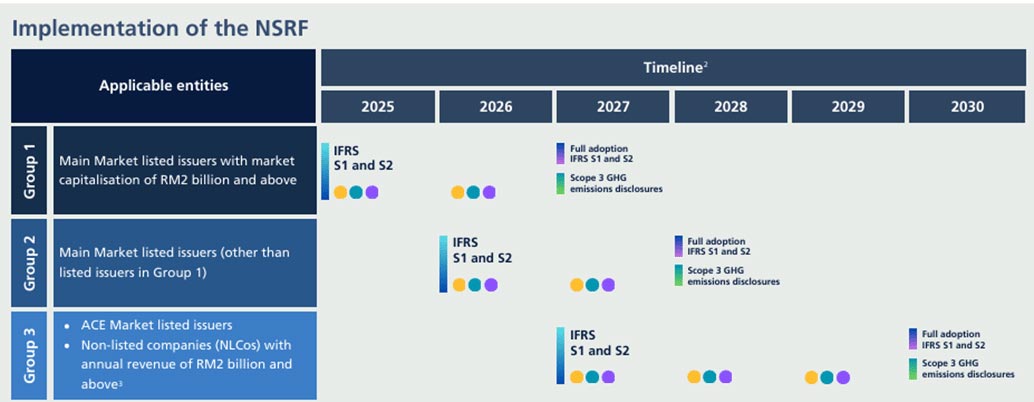
The NSRF follows a phased, developmental approach to allow businesses time to build internal capabilities. The adoption is divided into three groups:
Transition Reliefs & Assurance
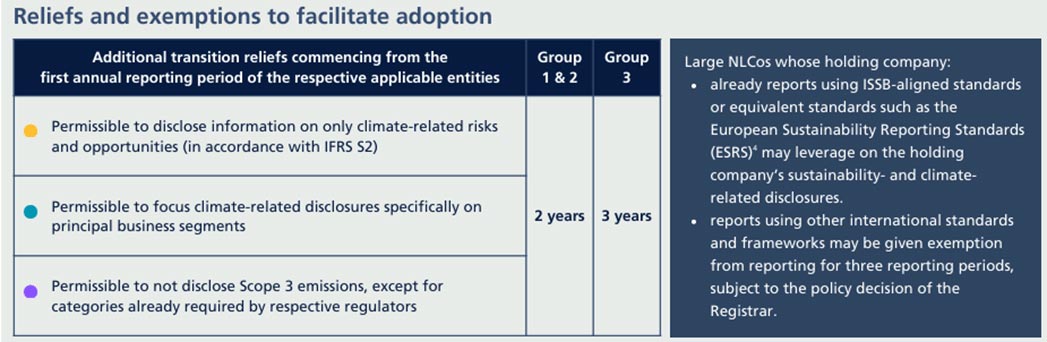
To facilitate a smoother transition, the NSRF extends Additional Transition Reliefs (ATR) for the first two reporting periods for Groups 1 and 2, and the first three reporting periods for Group 3.
Furthermore, to combat greenwashing and ensure data integrity, the framework will eventually mandate external assurance. The goal is to require reasonable assurance for Scope 1 and Scope 2 Greenhouse Gas (GHG) emissions for Group 1 companies starting from annual reporting in 2027.
| Group | Reasonable assurance for annual reporting periods beginning on or after16 |
|---|---|
| Group 1 | 1 January 2027 |
| Group 2 | 1 January 2028 |
| Group 3 | 1 January 2029 |
Conclusion
The National Sustainability Reporting Framework is a clear signal that the "wait and see" period for climate action is over. For Malaysian businesses, the next three years will be a period of intense learning and adaptation. By embracing these standards now, companies can secure their place in the global economy, protect their reputations against greenwashing, and contribute to a more resilient Malaysia.