

In the current global economic landscape, Environmental, Social, and Governance (ESG) considerations are no longer just buzzwords for multinational corporations; they have become integral to the resilience and relevance of Small and Medium Enterprises (SMEs) in Malaysia. As the backbone of the Malaysian economy—accounting for 97.2% of total business establishments and providing employment for 7.3 million people—SMEs are now at a critical juncture.
Transitioning toward sustainable and low-carbon practices is no longer a choice but a necessity for SMEs to remain competitive, attract investment, and maintain their positions in global supply chains. Climate change is making a profound impact on the "triple bottom line": planet, people, and profit. This comprehensive guide explores the Malaysian ESG landscape, providing a roadmap for SMEs to navigate regulatory requirements, implement ethical labour practices, and leverage available incentives.
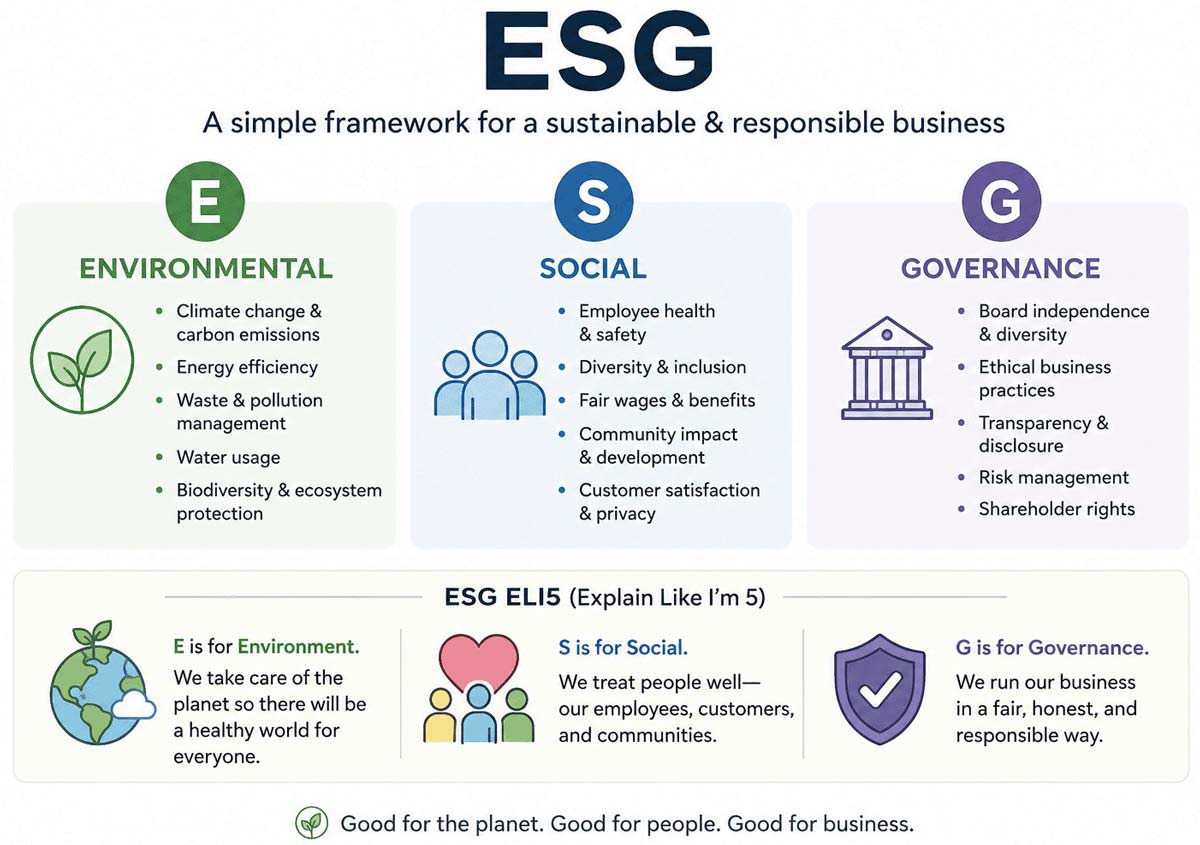
To begin the journey, SMEs must understand what ESG actually entails. It is a framework used to evaluate an organisation's impact beyond just its financial balance sheet.
For Malaysian SMEs, the goal of ESG is to capture "non-financial risks and opportunities" that are essential to daily business activities.
While some may view ESG as a burden, it offers significant long-term benefits that outweigh the initial costs of adoption.
Large Public Listed Companies (PLCs) and Multinational Corporations (MNCs) are increasingly prioritising ESG in their procurement processes. SMEs that fail to demonstrate ESG alignment risk being excluded from these high-value supply chains. Conversely, those who adopt ESG can expand into wider export markets that demand strict sustainability disclosures.
Investors and lenders are now using ESG ratings to assess the strength and sustainability of a company. Financial institutions in Malaysia are increasingly setting ESG criteria for loans. Demonstrating strong ESG practices can improve investor confidence and provide better access to capital.
Investing in green technology and energy efficiency can lead to significant reductions in operational costs. For example, proactive energy management has helped some Malaysian organisations achieve millions in annual energy cost savings.
The regulatory landscape in Malaysia is rapidly maturing. ESG disclosures are moving from voluntary statements to structured, auditable commitments. Early adoption allows SMEs to lead the conversation rather than reacting to sudden regulatory shifts.
The Malaysian government and various regulatory bodies have introduced several frameworks to guide the nation's transition toward a sustainable economy.
Launched by the Securities Commission Malaysia (SC), the NSRF is the national strategy to align local sustainability reporting with the global baseline set by the International Sustainability Standards Board (ISSB)—specifically IFRS S1 and IFRS S2.
While reporting requirements are being phased in, SMEs—particularly those categorised as ACE Market companies and large non-listed entities (Large NLCos with RM2 billion revenue)—will be required to comply by the annual reporting period beginning 1 January 2027. This framework aims to ensure that "Corporate Malaysia" provides consistent, comparable, and reliable sustainability information to investors.
The Ministry of Investment, Trade and Industry (MITI) introduced the National Industry ESG (i-ESG) Framework specifically for the manufacturing sector.
For many SMEs, the "Social" pillar is where they face the most immediate scrutiny, particularly regarding human rights and labour practices.
Forced labour refers to situations where individuals are compelled to work against their will under threat of punishment. In Malaysia, businesses must be vigilant against indicators of forced labour, such as:
In accordance with Malaysia's Act 350 (Children and Young Persons Employment Act 1966), a "child" is someone under 15, and a "young person" is between 15 and 18. While light work may be permitted under specific family or government-sponsored conditions, no child or young person should be engaged in "hazardous work" that jeopardises their health, safety, or morals.
A critical part of the Social pillar is establishing clear and transparent grievance mechanisms. These allow employees and stakeholders to raise concerns and seek solutions for potential negative impacts without fear of recrimination.
SMEs can begin their journey through a simple three-step approach:
As SMEs progress, they will need to formalise their reporting. The Simplified ESG Disclosure Guide (SEDG) is specifically designed to help SMEs in supply chains disclose relevant data aligned with international standards.
Malaysian companies are increasingly expected to adopt a hybrid reporting approach, combining Bursa Malaysia's requirements with global standards like the Global Reporting Initiative (GRI) and IFRS S1/S2.
An ESG audit is an independent evaluation of a company's sustainability reporting. It provides tangible evidence to investors and regulators that sustainability claims are well-managed and not just "greenwashing". Under the NSRF, external assurance over sustainability disclosures will become mandatory in phases, starting in 2027 for the largest entities and progressing to ACE Market and large non-listed entities by 2029.
The Malaysian government offers several incentives to ease the cost of compliance for SMEs:
While the path to ESG adoption can be daunting due to costs, lack of standardisation, and limited expertise, the risks of inaction are far greater. SMEs that wait until compliance is mandatory risk falling behind in both credibility and competitiveness.
To succeed, SME leaders must:
The ESG framework in Malaysia is evolving rapidly. For SMEs, the "Just Transition" phase is the perfect opportunity to build capacity and integrate sustainable practices into their core operations. By embracing ESG today, Malaysian SMEs are not just complying with regulations-they are building a resilient, future-ready business that can thrive in the global green economy.

